
%20(1).png)
Why Litigation Oversight Matters
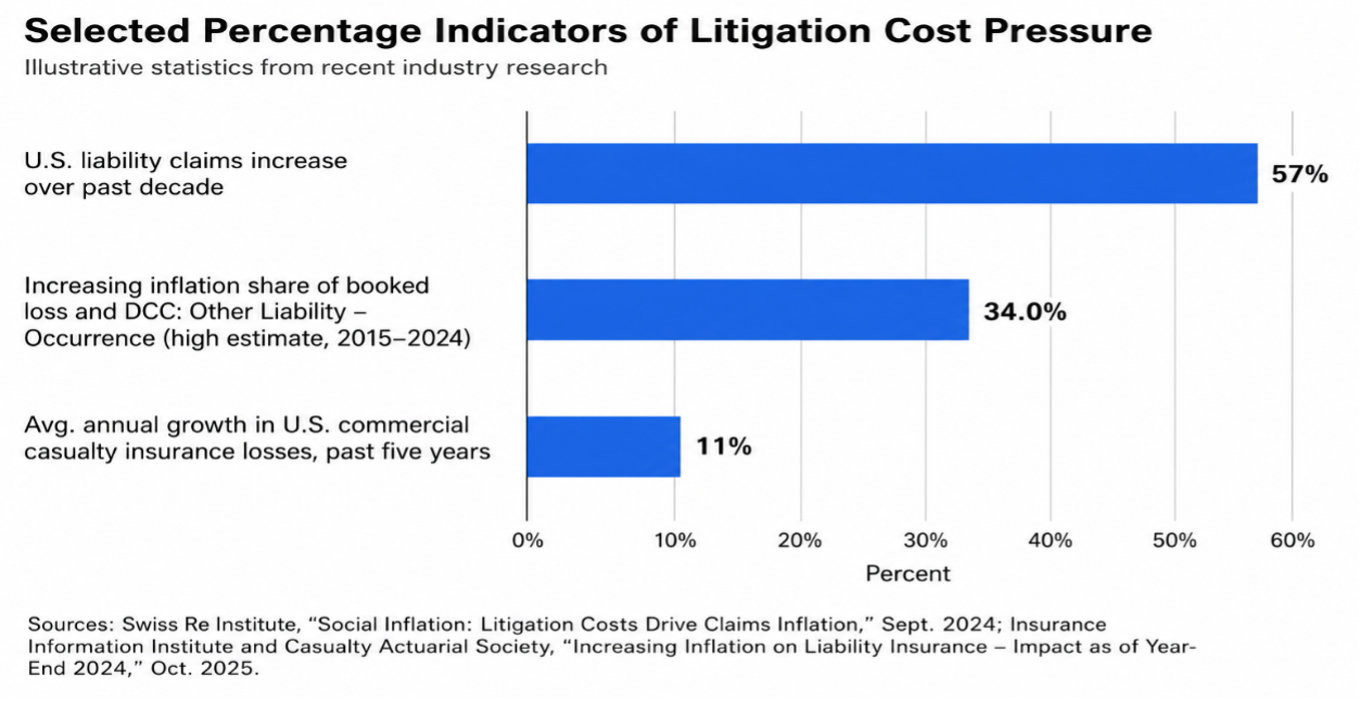
Escalating claim values, higher defense costs, and longer case durations are increasing pressure on insurers' legal spend and claims outcomes. Social inflation, including larger jury awards and third-party litigation funding, is adding to that pressure by driving defense and cost containment (DCC) costs higher across liability lines. A strategic litigation management program helps address these pressures by bringing more consistency to litigation oversight, budgeting, and performance review. 1
Where Costs Escalate
Litigation management has often been handled on a case-by-case basis rather than through a broader framework. That approach is harder to sustain in the current environment, where broader discovery, plaintiff-friendly venues, and larger verdicts often call for earlier intervention and closer oversight. In practical terms, that means more consistent reporting, shared metrics, and closer coordination across claims, legal, and finance.2
Effective litigation management starts with governance. Some insurers have opportunities to strengthen their frameworks, particularly around escalation protocols, oversight of outside counsel, and accountability for legal spend. Clear litigation guidelines can support more consistent decisions on settlement strategy, trial posture, and reserve adequacy. As DCC costs rise, litigation governance becomes more than an administrative issue; it also becomes a cost-control issue. 3
What Stronger Management Looks Like
Budget discipline remains one of the clearest ways to improve litigation oversight. Industry analysis shows that liability losses and DCC expenses have risen meaningfully in recent years, underscoring the scale of litigation-related cost pressure. 4 Without budgeting and variance review, defense costs can expand through broader discovery, expert expenses, and prolonged litigation. A more structured program uses case-level and phase-based budgets, tracks variance against plan, and analyzes litigation activity to identify cost outliers and improve forecasting.
Many panel counsel arrangements still reflect historical relationships more than measured results. As cases become more complex and jury awards increase, counsel selection increasingly depends on data as well as experience. Metrics such as cost per litigated claim, time to resolution, staffing patterns, and settlement versus trial outcomes can provide a better basis for evaluating law firm performance. Industry research suggests that more complex litigated matters can generate higher defense costs. 5
Strong litigation management programs measure results consistently and use those findings to adjust strategy over time. Metrics such as defense cost as a percentage of indemnity, budget adherence, cycle time to resolution, and staffing efficiency can help insurers assess performance and identify areas for improvement. Periodic reporting and dashboards can also help organizations identify cost patterns, compare counsel performance, and refine litigation strategy over time. 6
From Litigation Pressure to Management Response
How SIMS Supports the Process
Alan Gray's Smart Invoice Management System (SIMS) helps insurers improve visibility into DCC trends, law firm performance, and litigation cost drivers, supporting stronger oversight of legal spend and litigated matters.
Core SIMS Capabilities Include:
- E-billing and legal invoice review with guideline adherence
- Budget tracking and variance monitoring for litigated claims
- Legal spend analytics, dashboards, and portfolio-level DCC visibility
- Panel counsel performance analysis
- On average, savings achieved using SIMS exceed the cost of the service
- Accounts reviewed by expert analysts
Through independent analytics and benchmarking, SIMS helps organizations identify cost outliers, strengthen oversight, and improve litigation cost control.
Citations
- Swiss Re Institute. Social Inflation: Litigation Costs Drive Claims Inflation (Indexing Liability Loss Trends). Sigma 4/2024, Swiss Re Institute, Sept. 2024.
- U.S. Chamber of Commerce Institute for Legal Reform. Nuclear Verdicts: An Update on Trends, Causes, and Solutions. 30 May 2024.
- National Association of Insurance Commissioners. Annual Statement Instructions—Property/Casualty, Schedule P. NAIC, 2025.
- Insurance Information Institute and Casualty Actuarial Society. Increasing Inflation on Liability Insurance: Impact as of Year-End 2024. Insurance Information Institute, 30 Oct. 2025.
- Gen Re. "Litigation Analytics – Turning Data into a Competitive Advantage for Casualty Insurers." Gen Re, 11 Aug. 2025.
- Thomson Reuters. "Discover the Opportunities Hiding in Your Law Department Data." Thomson Reuters Legal, 13 Dec. 2021.

-2.png)

-2.png)