

%20(1).png)
New York City’s construction safety numbers improved in 2024, but construction litigation in the city still warrants close attention. The city reported 638 construction-related incidents in 2024, down about 24% from 2023, and 482 injuries, down about 30% year over year.1 However, serious losses remain concentrated in falls, and New York law gives those accidents unusual significance in construction claims.
For insurers, contractors, owners, and claims teams, that distinction matters. A market can improve on frequency and still produce difficult, expensive claims when the losses that remain are concentrated in one hazard category. In New York, falls still drive much of that story, and Labor Law § 240 gives those accidents a liability profile that differs from an ordinary negligence case.1, 2
Why New York Stands Apart
The main reason is Labor Law § 240, the Scaffold Law. It requires covered owners, contractors, and their agents to furnish or erect protective devices such as scaffolds, ladders, hoists, slings, and hangers for certain construction-related work.2 New York, in other words, has a statute aimed directly at height-related construction risk. This is not the same case in other states.
The best public comparison remains older insurer data from Chubb and Aon using New York construction losses from 2011 through 2019. That study reported the following statistics comparing New York workers’ compensation claims vs national averages:
Comparison of Insurers New York Construction Claim Experience
The study is dated and should be treated that way, but it still points to a New York claim environment that has been materially heavier than what insurers have seen elsewhere.
Why the Topic Still Matters
This is not a simple story of rising accidents. NYC’s own data points the other way. The serious cases that still occur are the ones most likely to involve catastrophic injury, multiple parties, and a plaintiff-favorable liability framework. For that reason, the litigation exposure remains significant. That is the better way to think about New York construction litigation. The issue is not accident count alone, but the types of accidents that still occur. In New York, those accidents still center heavily on falls.1, 2
Why Falls Drive Severity
Falls account for a larger share of reported injuries in NYC construction than in broader U.S. construction injury data. In New York City, worker falls made up 52.5% of reported construction injuries in 2024. Nationally, the broader “falls, slips, and trips” category accounted for about 30.6% of nonfatal construction injuries involving days away from work, job restriction, or transfer.1, 4
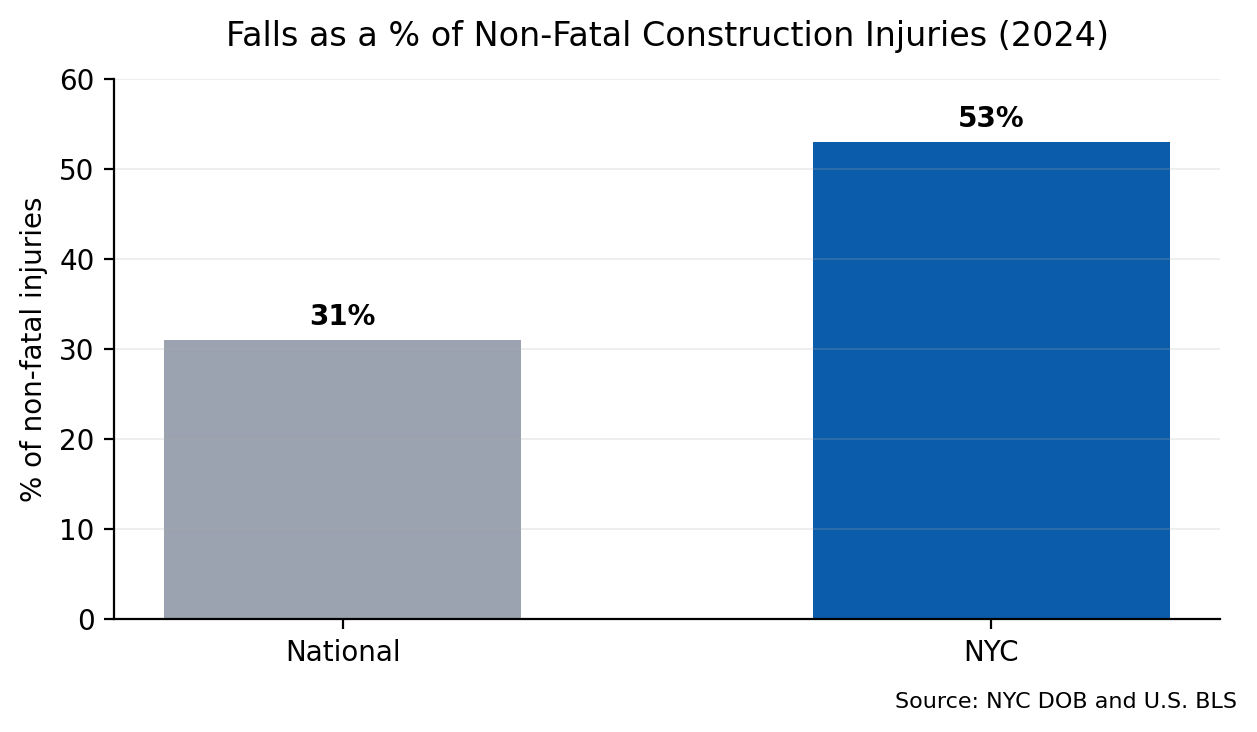
Falls also tend to produce the injuries that drive claim severity: traumatic brain injury, spinal injury, fractures, internal injury, permanent disability, and death. OSHA notes that outcomes can range from sprains and concussions to death.6 That mix of frequency and injury seriousness is why fall claims stay at the center of New York construction litigation.
How Labor Law § 240 Shapes Claims
Section 240 matters because it is aimed at the exact hazards behind many of the worst construction losses. A serious fall in New York may not stay a workplace injury matter. It can expand into a larger liability dispute involving owners, contractors, tenders, indemnity issues, and multiple carriers.2
Why a serious fall claim can become more expensive in New York
- Labor Law § 240 may strengthen the liability case when proper safety devices were not provided.
- More parties may be drawn into the dispute, including owners, contractors, and carriers.
- Indemnity, tender, defense, and judgment costs can rise quickly.
- New York’s 9% statutory interest rate can further increase exposure after judgment.

Why the 2025 Construction Insurance Transparency Act Matters
The current debate over the Construction Insurance Transparency Act of 2025 shows that the cost side of this issue is still active. The Assembly and Senate bills would require insurers providing coverage for liability under the Scaffold Law to report annual financial and claims information to the superintendent of financial services.8 Even before any data is published, the bill shows that Scaffold Law-related insurance cost remains important enough to attract a transparency push.
It also helps explain why older insurer studies still carry so much weight. There is still no equally visible public dataset showing premiums, settlements, reserves, paid losses, and defense costs tied to this exposure.3, 8 The debate persists because the public data is still thinner than many market participants would like.
Bottom line
Even with improved safety numbers, fall-driven severity and New York’s liability framework continue to make this a meaningful claims issue.
- Falls remain a disproportionate driver of serious New York construction claims.
- Labor Law § 240 can materially affect liability and claim economics.
- Public debate over Scaffold Law-related cost and transparency remains active.
Citations
- New York City Department of Buildings. 2024 Construction Safety Report. 2025.
- New York State Senate. Labor Law § 240.
- Chubb and Aon. Preparing for the Statute’s Outsized Impact on Liability Risks. New York Labor Law and Construction Loss Data (based on 2011–2019 New York construction losses).
- U.S. Bureau of Labor Statistics. A Look at Falls, Slips, and Trips in the Construction Industry. 2024.
- Occupational Safety and Health Administration. National Safety Stand-Down to Prevent Falls in Construction. 2025 update citing 2024 fatality data.
- Occupational Safety and Health Administration. Construction eTool: Falls.
- N.Y. C.P.L.R. 5004(a) (rate of interest generally nine percent per annum, except where otherwise provided by statute). See also Saint v. Syracuse Supply Co., 25 N.Y.3d 117, 124 (2015) (describing Labor Law § 240(1) as imposing a nondelegable duty and absolute liability for injuries proximately caused by failure to provide appropriate safety devices).
- New York State Assembly and Senate. Construction Insurance Transparency Act of 2025 (A5811 / S8200).
-2.png)

-2.png)
-2.png)


