

Legal invoice technology represents an investment in expense control. For insurers, the financial assessment needs to follow potential billing exceptions through review, clarification, and appeal, then account for the cost of operating the program.
That assessment is becoming more relevant as defense costs rise. In the 2026 CLM Litigation Management Study, 75.8% of respondents reported that average legal fees and costs per litigated case had increased over the preceding three years. The study gathered responses from more than 70 senior claims and litigation executives.1
Its findings also provide a reference point for invoice reductions. Respondents estimated that adjustments on panel counsel invoices averaged 6.3% after appeals, with a median of 5%.1 These estimates describe reductions achieved through the review process.
For claims leadership, the practical question is how technology contributes to a process that produces supportable adjustments at an appropriate cost. The answer requires attention to the amounts ultimately approved, the time spent resolving exceptions and the billing practices that improve as a result.
Key Takeaways
- Measure the savings that remain. Final reductions after appeals, less the cost of software, review and administration, provide the clearest measure of financial value.
- Resolve flags with informed review. Approved rates, billing guidelines and claim circumstances help reviewers sustain adjustments and approve supported charges.
- Use each review to improve future billing. Address recurring exceptions and missing approvals to reduce disputes, review time and avoidable expense on subsequent invoices.
Following the Dollars Through Review
The following illustration applies CLM’s reported 6.3% average reduction to a hypothetical $1 million in submitted invoices, producing $63,000 in final reductions. The amounts flagged and initially proposed for adjustment are assumptions that illustrate the intervening review steps. Review program costs are excluded. For example, if annual review costs were $15,000, the $63,000 in final reductions would leave $48,000 in net savings. The review cost assumption is illustrative.
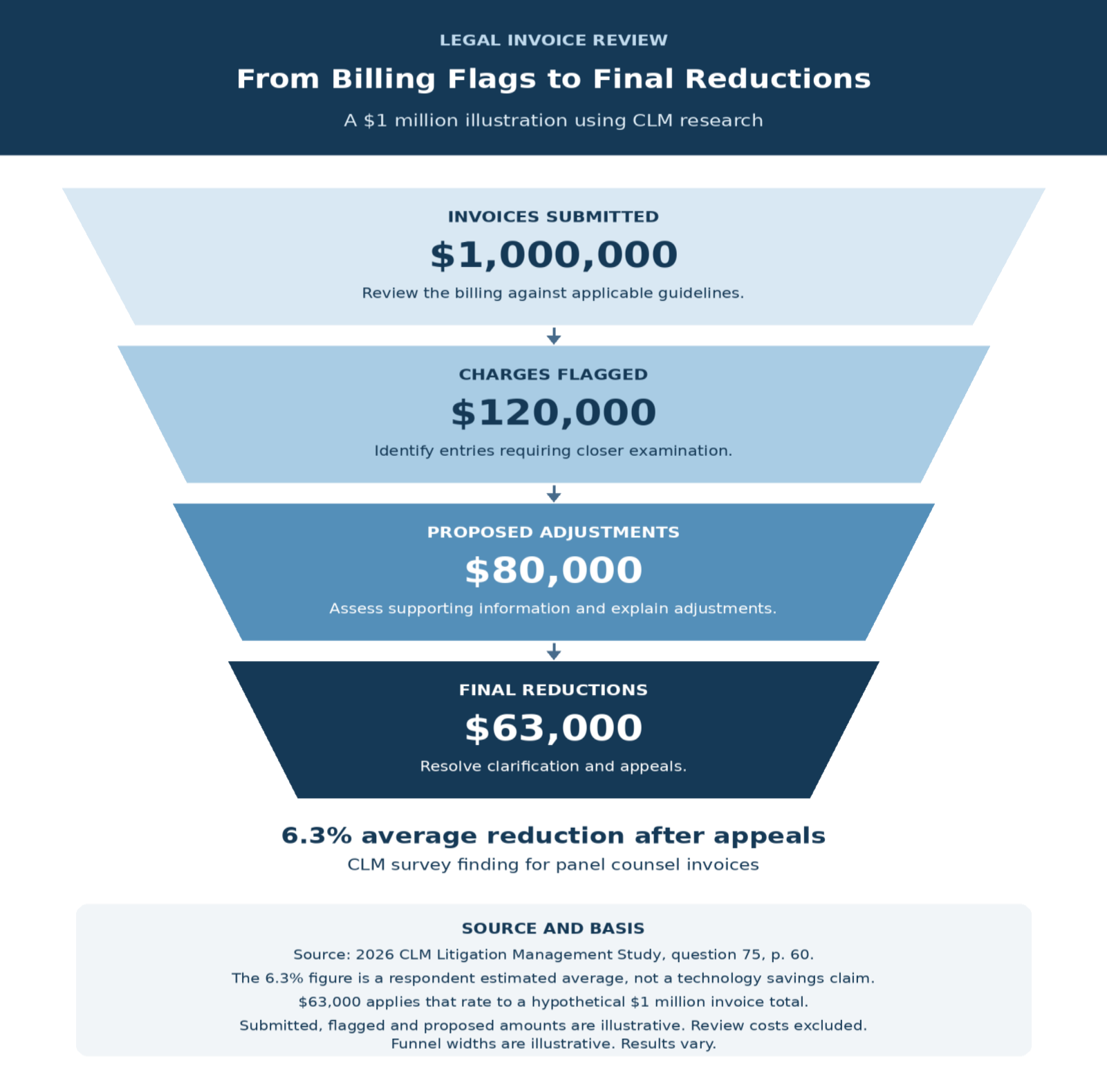
Source: 2026 CLM Litigation Management Study. The final amount applies the reported average reduction on panel counsel invoices to a hypothetical billing total. Submitted, flagged and proposed amounts are illustrative.
The difference between the stages matters. Some flagged charges will be approved after examination. Proposed adjustments may change when counsel supplies additional information. Management reports should distinguish those amounts and identify invoices still awaiting appeal. The cost of review then determines how much of the financial benefit remains.
Recurring Savings and Benefits From Ongoing Review
An ongoing review program can also produce recurring reductions as new invoices are submitted. Each sustained adjustment applies to the invoice reviewed, while subsequent billing periods create additional opportunities to identify and resolve exceptions. CLM’s question asks respondents to estimate annual reductions after appeals.1 The reported average provides context for an ongoing process, although an insurer’s results will vary with billing volume, compliance and claim mix.
Improvements in billing practices may also reduce future exceptions and the work required to resolve them. A lower adjustment rate can therefore accompany a more efficient program. Management should examine final reductions, review costs and billing quality together when assessing value over successive periods.
Technology and Professional Review Work Together
CLM’s research shows widespread use of legal invoice review software alongside professional review resources.
Source: 2026 CLM Litigation Management Study. Findings reflect respondent reports and do not establish results caused by technology.1
The management question is how those resources work together. A system may identify an exception quickly, but the organization still needs a defined route for obtaining information, evaluating the charge and recording the result.
Legal invoice technology can support checks for agreed rates, duplicate entries and potential departures from billing guidelines. Some services combine automated analysis with professional review and appeal management. Wolters Kluwer, for example, describes an offering that combines technology with legal bill review professionals.2
Track the time spent on automated checks, professional review and claims approvals. This shows where the program saves work and where delays remain.
A Billing Flag Requires a Decision
Consider a hypothetical invoice showing that two attorneys attended the same hearing. The system flags the entries for possible duplicate staffing. Counsel explains that one attorney argued the motion while the other addressed a separate issue involving an expert witness.
The reviewer needs to establish whether those roles were authorized and adequately supported. The entries may be approved, adjusted or returned for clarification. The flag has identified a question requiring resolution.
Other exceptions may be more straightforward. A rate discrepancy can often be assessed against the applicable agreement and its effective date. An entry for substantial research time requires information about the issue investigated, the scope of the assignment and the work already completed. This is relevant when several flags arise from one underlying issue. A single entry may trigger multiple checks, while several entries may relate to the same approved assignment.
Examining the Work Behind the Charge
Reviewers assess charges against approved rates, staffing arrangements and billing guidelines, taking account of the assignment and any authorization. The claim’s circumstances may explain additional research, a lengthy conference or multiple attorneys working on an urgent matter. Counsel’s explanation must provide enough detail to evaluate the charge. A proposed adjustment should identify the entry, the applicable requirement and the reason for the decision. Approved exceptions should also be documented to prevent repeated questions.
Appeals Affect the Result and the Cost
Counsel may challenge an adjustment or supply missing information. Reviewers need access to the original entry, applicable guidelines and prior approvals, with a clear route for questions requiring claims authority. Repeated reversals can reveal unclear descriptions, missing approvals or inconsistent review. Examining those patterns can reduce appeal costs and improve future instructions. The final record should explain what was approved or adjusted and why.
Measuring Performance Beyond the Reduction Rate
Performance reports should distinguish final reductions from unresolved appeals and account for changes in rates, claim complexity and the mix of firms. Those factors can affect adjustment percentages independently of review quality. Management should also track payment timing, appeal backlogs and recurring exceptions. Better billing compliance may lower the reduction rate while reducing review costs.
Turning Findings Into Better Billing Practices
Recurring exceptions can identify where billing instructions need clarification. Specific examples help counsel understand expectations for staffing, research and task descriptions. Claims professionals should confirm authorized work and changes in defense strategy. Consistent instructions across the claims teams can reduce billing disputes and repeated review.
A Practical Defense Invoice Review Example
An international property and casualty insurer retained Alan Gray for ongoing review of defense invoices. Alan Gray helped develop a comprehensive review system and oversaw negotiations and appeals with the firms involved. The engagement produced reported savings of 10% to 15% of legal costs within one year.3
The result illustrates the importance of following invoice issues through review, negotiation and appeal. The published summary does not isolate the contribution of a particular technology. For insurers assessing their own programs, the review scope, calculation method and final approved amounts should be clear enough to support the reported result.
Establishing the Value of the Investment
Legal invoice technology can help insurers examine billing more systematically. Its financial value depends on the review process built around it and the cost of operating that process. Claims leadership needs an account of the reductions retained after appeals, the resources used to achieve them and the recurring issues that have been addressed. The investment decision should rest on additional net savings, review time and billing compliance compared with the existing process. Those measures help claims leaders decide whether to expand the program, refine its rules or change how exceptions are resolved.
Citations
- Suite 200 Solutions. The 2026 CLM Litigation Management Study: Report of Findings. Claims and Litigation Management Alliance, Mar. 2026, questions 30, 69–72, and 75. Full report. Accessed 7 Oct. 2026.
- Wolters Kluwer. “LegalVIEW BillAnalyzer: AI Powered Legal Bill Review.” Product and service description. Accessed 7 Oct. 2026. Cited for its description of the service.
- Alan Gray LLC. “Legal Expense Management Services.” “Review of Defense Invoices.” Engagement summary. Accessed 7 Oct. 2026.